Join hosts Hank Green, Kallie Moore, and Blake de Pastino as they take you on a journey through the history of life on Earth. From the dawn of life in the Archaean Eon through the Mesozoic Era — the so-called “Age of Dinosaurs” -- right up to the end of the most recent Ice Age. The evolutionary history of mammals including humans and other modern species is explored with these amazing paleontology experts.
Join hosts Hank Green, Kallie Moore, and Blake de Pastino as they take you on a journey through the history of life on Earth. From the dawn of life in the Archaean Eon through the Mesozoic Era — the so-called “Age of Dinosaurs” -- right up to the end of the most recent Ice Age. The evolutionary history of mammals including humans and other modern species is explored with these amazing paleontology experts.
Season 6 episodes
Choose an episode, then use the watch options above for the show.
How our deadliest parasite turned to the dark side
10m
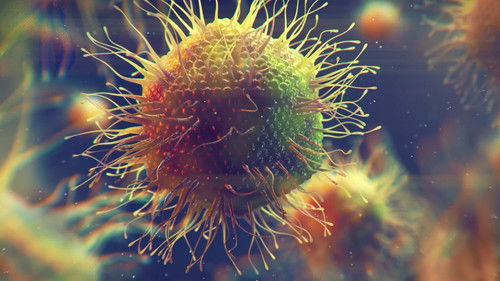
Around 10,000 years ago, somewhere in Africa, a microscopic parasite made a huge leap. With a little help from a mosquito, it left its animal host - probably a gorilla - and found its way to a new host: us.
The Snake Detection Hypothesis proposes that the ability to quickly spot and avoid snakes is deeply embedded in primates, including us - an evolutionary consequence of the danger snakes have posed to us over millions of years.
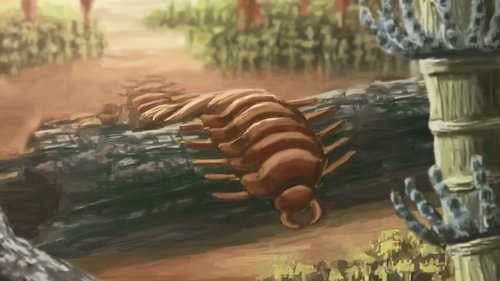
How the Rise of Social Insects Shrunk These Dinosaurs
10m
We often think of dinosaurs as either preying on other dinos or mammals, or as plant-eaters -- but in ecosystems today, those aren’t the only two options. So why would we expect dinosaurs to have only been carnivores or herbivores, with the occasional omnivore thrown in the mix?
Do our modern horses descend from just one domesticated population, or did it happen many times, in many places? Answering these questions has been tricky, as we’ve needed to bring together evidence from art, archaeology, and ancient DNA…Because, as it turns out, the history of humans and horses has been a pretty wild ride.
Today, all mammals from humans to bats have five fingers or fewer. Yes, even whales, whose finger bones are hidden in their fins. Birds have four or fewer and amphibians get the best of both worlds, often having four digits on their “hands” and five on their “feet.” But no species of vertebrates have more than five digits, let alone eight!
A truly enormous ichthyosaur around the size of a modern sperm whale, reached its size within just a few million years of taking to the water - a blink of an eye in evolutionary time.
We tend to think that evolution only goes in one direction— toward getting bigger and more advanced. But that’s not always the case. This tiny, simple animal, the Myxozoans, (yes, animal!) evolved from something bigger and more complex.
While sour taste's original purpose was to warn vertebrates of danger, in a few animal groups, including us, its role has reversed. The taste of danger became something it was dangerous for us to avoid.
Only a handful of Denisovan fossils have been identified. In the absence of actual body fossils, it’s impossible for us to reconstruct their morphology, right?
While we’ve been farming for around 10,000 to 12,000 years, the ancestors of ants have been doing it for around 60 million years. So when, and how, and why did ants start … farming?
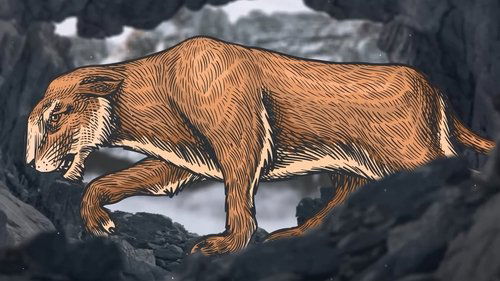
A mysterious, large feline roamed Eurasia during the last ice age. Its fossils have been found across the continent, and it’s been the subject of ancient artwork. So what exactly were these big cats?
Fossil evidence suggests Diictodon used burrows to breed, and that a parent stayed behind to feed and protect their young. And the parent that stayed behind? It might’ve been the male.
Something Has Been Making This Mark For 500 Million Years
11m
Paleodictyon, a hexagonal-patterned fossil, is a bit of a mystery. We don’t even know if it’s a trace fossil, or the organism itself. So… what could it be?
In 2003, microbiologists made a huge discovery. One that would force us to reconsider a lot of what we thought we knew about the evolution of microbial life: giant viruses.
Despite the profound changes we’ve made here in recent history, the epic saga of Los Angeles' natural history is still visible - and even striking - if you know where and how to look for it.
Today, billions of people around the world start their day with caffeine. But how and why did the ability to produce this molecule independently evolve in multiple, distantly-related lineages of flowering plants, again and again?
There is one - and only one - group of mammals that doesn’t have alpha-gal: the catarrhine primates, which are the monkeys of Africa and Asia, the apes, and us.
Mystacodon is the earliest known mysticete, the group that, today, we call the baleen whales. But if this was a baleen whale, where was its baleen? Where did baleen come from? And how did it live without it?
Mercury, Venus, and Mars are all super low on water – so where did ours come from and why do we have so much of it? We think our water came from a few unlikely sources: meteorites, space dust, and even the sun.