Episode 1
The Dawn of History
The origins of the human race are traced from anthropoid ancestors to the agricultural revolution.
TV series
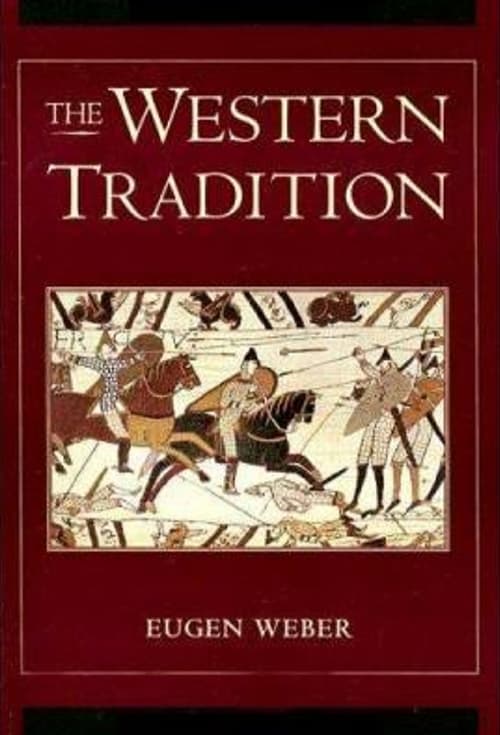
Covering the ancient world through the age of technology, this illustrated lecture by Eugen Weber presents a tapestry of political and social events woven with many strands — religion, industry, agriculture, demography, government, economics, and art. A visual feast of over 2,700 images from the Metropolitan Museum of Art portrays key events that shaped the development of Western thought, culture, and tradition.
See where to watchStreaming, rental and purchase options
Covering the ancient world through the age of technology, this illustrated lecture by Eugen Weber presents a tapestry of political and social events woven with many strands — religion, industry, agriculture, demography, government, economics, and art. A visual feast of over 2,700 images from the Metropolitan Museum of Art portrays key events that shaped the development of Western thought, culture, and tradition.
Watch options above are for the show and may vary by season or episode.
Episode 1
The origins of the human race are traced from anthropoid ancestors to the agricultural revolution.
Episode 2
Egyptian irrigation created one of the first great civilizations.
Episode 3
Settlements in the Fertile Crescent gave rise to the great river civilizations of the Middle East.
Episode 4
Metals revolutionized tools, as well as societies, in the empires of Assyria, Persia, and Neo-Babylonia.
Episode 5
Democracy and philosophy arose from Greek cities at the edge of the civilized world.
Episode 6
Socrates, Plato, and Aristotle laid the foundation of Western intellectual thought.
Episode 7
Alexander's conquests quadrupled the size of the world known to the Greeks.
Episode 8
Hellenistic kingdoms extended Greek culture throughout the Mediterranean.
Episode 9
Through its army, Rome built an empire that shaped the West.
Episode 10
Rome's civil engineering contributed as much to the empire as did its weapons.
Episode 11
Christianity spread despite contempt and persecution from Rome.
Episode 12
The old heresy became the Roman empire's official religion under the Emperor Constantine.
Episode 13
While enemies slashed at Rome's borders, civil war and economic collapse destroyed the empire from within.
Episode 14
Despite the success of emperors such as Hadrian and Marcus Aurelius, Rome fell victim to barbarian invasions.
Episode 15
From Constantinople, the Byzantine Empire carried on the traditions of Greece and Rome.
Episode 16
Nearly a thousand years after Rome's fall, Constantinople was conquered by the forces of Islam.
Episode 17
Barbarian kingdoms took possession of the fragments of the Roman Empire.
Episode 18
Charlemagne revived hopes for a new empire in Western Europe.
Episode 19
Amid invasion and civil disorder, a military aristocracy dominated the kingdoms of Europe.
Episode 20
Bishop, knight, and peasant exemplified some of the social divisions of the year 1000 A.D.
Episode 21
Famine, disease, and short life expectancies were the conditions that shaped medieval beliefs.
Episode 22
The great churches embodied the material and spiritual ambitions of the age.
Episode 23
Two hundred years of war and plague debilitated Europe.
Episode 24
A new urban middle class emerged, while dynastic marriages established centralized monarchies.
Episode 25
Renaissance humanists made man "the measure of all things." Europe was possessed by a new passion for knowledge.
Episode 26
The discovery of America challenged Europe.
Episode 27
Voiced by Martin Luther, Protestantism shattered the unity of the Catholic Church.
Episode 28
As the cities grew, new middle-class mores had an impact on religious life.
Episode 29
For more than a century, the quarrels of Protestants and Catholics tore Europe apart.
Episode 30
Amid religious wars, a few cities learned that tolerance increased their prosperity.
Episode 31
Exhausted by war and civil strife, many Europeans exchanged earlier liberties and anarchies for greater peace.
Episode 32
Arguments about the legitimate source of political power centered on divine right versus natural law.
Episode 33
Monarchs considered reforms in order to create more efficient societies, but not at the expense of their own power.
Episode 34
Intellectual theories about the nature of man and his potential came to the fore.
Episode 35
Scientists and social reformers battled for universal human rights during a peaceful and prosperous period.
Episode 36
Freedom of thought and expression opened new vistas explored by French, English, and American thinkers.
Episode 37
The British colonists created a society that tested Enlightenment ideas and resisted restrictions imposed by England.
Episode 38
A new republic, the compromise of radicals and conservatives, was founded on universal freedoms.
Episode 39
In France the old order collapsed under revolutionaries' attacks and the monarchy's own weakness.
Episode 40
Liberty, equality, and fraternity skidded into a reign of Terror.
Episode 41
Technology and mass production reduced famine and ushered in higher standards of living.
Episode 42
A consumer revolution was fueled by coal, public transportation, and new city services.
Episode 43
Leaders in the arts, literature, and political theory argued for social justice and national liberation.
Episode 44
The great powers cooperated to quell internal revolts, yet competed to acquire colonies.
Episode 45
Public education and mass communications created a new political life and leisure time.
Episode 46
Everyday life of the working class was transformed by leisure, prompting the birth of an elite avant-garde movement.
Episode 47
Old empires crumbled during World War I to be replaced by right-wing dictatorships in Italy, Spain, and Germany.
Episode 48
World War II was a war of new tactics and strategies. Civilian populations became targets as the Nazi holocaust exterminated millions of people.
Episode 49
The U.S. and Soviet Union dominated Europe and confronted each other in Korea.
Episode 50
Burdened with the legacy of colonial imperialism, the Third World rushed development to catch up with its Western counterparts.
Episode 51
Keeping up with the ever-increasing pace of change became the standard of the day.
Episode 52
Modern medicine, atomic energy, computers, and new concepts of time, energy, and matter all have an important effect on life in the 20th century.
Episode information updated Jul 22, 2026
More shows like The Western Tradition.